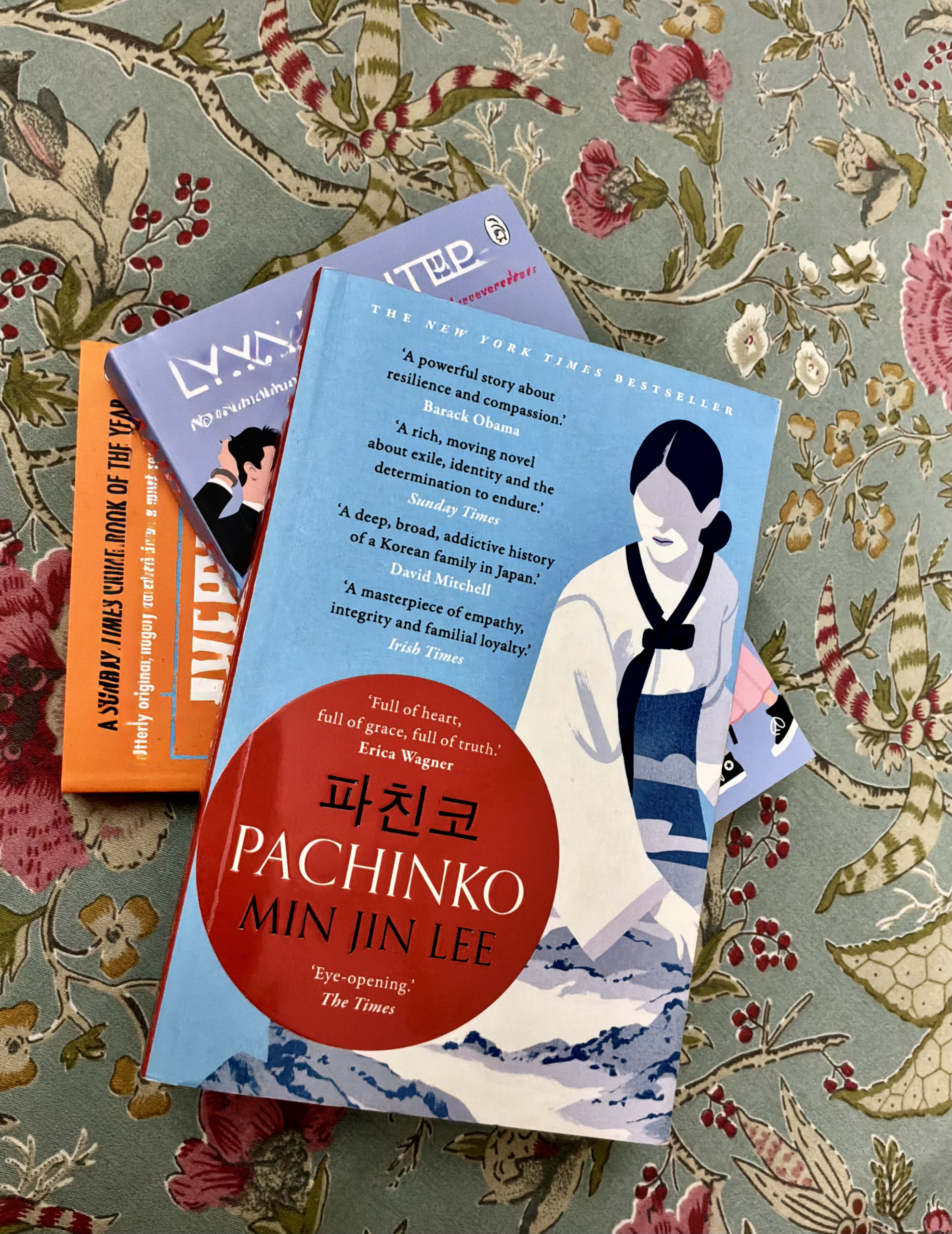
Pachinko, Min Jin Lee, is the 5th book I’ve read this month, and the first focusing on Asian countries. I had always believed that the macroscopic setting of a book, i.e the country or subcontinent, did not matter much since it held no bearing on the day-to-day lives of characters. In general, I found this to be true for historical fictions as well, where invasions or bombings only held impact to show general fear or loss of a loved one. The Light in Hidden Places, Sharon Cameron, and Purple Hibiscus, Chimamanda Ngozi Adichie, in fact, showed how internal streams of consciousness and small events, sneezing, deviating from routines, taking a walk in the sun, can have a much larger personal impact than macroscopic decisions of one country invading another. Hence, I picked up this book with curiosity, sprinkled with a healthy dose of apprehension, braced for a overly-complicated and difficult-to-follow story.
Pachinko, however, shattered these illusions. A story about immigration and family, it spans over 3 generations, showing how Japan’s invasion of Korea and the subsequent decisions taken by one small non-political family impacted their lives for generations to come. One of the most appreciable facets of the telling is the ability to show multiple different lifestyles parallelly, without condemnation or comparing. Unlike most books, which portray “Western” living as the ideal, or condescend wishes and attempts made by immigrants to fit into a new society, Lee manages to unbiasedly show the differences between Korean, Japanese and American methods of living. Amazingly, she has mastered the capability of detailing difficult issues, like infidelity, prostitution and suicide, not only without judgment, but also without justification, approaching them with a detached compassion, an acknowledgment of their presence without overly expounding on their characteristics.
I was also hesitant in reading a book spanning multiple generations, but Pachinko has one of the most seamless transitions, both geographic and temporal. Written in third person, it focuses on events rather than characters, where the conversation with context holds more importance than the internal monologue of any character. While the reader is privy to some silent feelings and thoughts, these are not centred on any one character. Rather, a few lines are devoted to each, helping to outline peoples’ pasts and their motivations, and also eliminating the concept of “main” and “side” characters. This parallels with life as well, because everyone coexists in a paradox of independence and mutual dependence, where no one person’s thoughts or feelings are more important than the other. This masterful telling is complemented by her writing style of using events to show emotions rather than spending multiple paragraphs on explaining thoughts and feelings.
(Spoiler!)
An example, is when Noa leaves home after a “big reveal”, cutting off all ties with his old life, makes a life for himself, managing to fit into “Japanese” people through lies of omission. He sets-up a life for himself, and his mother is able to re-establish contact only 16 years later. Overwhelmed, she goes to meet him face-to-face, discarding the original plan to observe from a distance, and they have, what initially appears to be a genial and loving reunion with promises to remain in touch. The next day, she gets a phone call telling her that Noa committed suicide a few minutes after she left.
This scene is powerful, not only because of the twist in the end, but because that twist shows a lifetime of agony and suffering born of a three-decade old mistake by parents and a struggle to “fit in”, a fight fought every day by the children of immigrants.
(Spoiler Ends)
The beauty of the book lies not only in the portrayal of the complexity of human character and their recognition, but also in the utilisation of various underlying themes that influence actions of people in real life. Religious differences, naivety of teenagers, loss and grief, personal sacrifice, and the effect of parents’ decisions on their children are important themes throughout the novel which influence actions and opportunities.
(Spoiler!)
A scene that perfectly portrays the irony of life is when a child born of “gangster” blood aspires to be a “gentle scholar” while the son of a Christian minister plans to earn money and become a “big man” so that his mother need not work so hard. The idea that life often does not turn out to be as planned is also beautifully showcased in sparsely spaced scenes, where both children end-up working in a similar profession.
(Spoiler ends)
Ultimately, Pachinko, is a beautiful portrayal of life and human character. It acknowledges difficulties faced by immigrants, especially those who continue to face discrimination despite being settled in a nation for 3 generations, and weaves these into a personal narrative, showing their recurring impact. This is particularly important because not everything has a consistent impact, some things affect us by cropping up every now and then. Lee has managed to write one of the most consistent portrayals of human life while managing to remove personal judgment, bias and opinions to compassionately show all sides of a society and the difficult decisions that need to be made by many.